Local social platform for communities & small businesses
Designing a social platform that helps local communities discover businesses, connect with neighbors, and build stronger local economies.
Services
Product Strategy · UX Research · Product Design · Design System
Industry
Social Network · Marketplace
Platform
iOS · Android
Overview
Local businesses often struggle to compete with large marketplaces, while residents rarely know what is happening just a few streets away. Our client wanted to bridge this gap by creating a social-first platform where communities could discover nearby services, local events, offers, jobs, and connect with people around them.
Instead of building another marketplace, the goal was to create an engaging ecosystem that combines social networking with local commerce, making every interaction feel natural and community-driven.
The challenge
Creating a social platform is significantly more complex than designing a traditional mobile application. Every screen depends on user-generated content, multiple user types, and constantly evolving interactions.
The product needed to balance two completely different audiences: people looking for local information and businesses trying to promote their services without feeling like advertisements.
The biggest challenge was creating an experience where commerce naturally fits into social interactions rather than interrupting them. The platform also had to support rapid feature expansion without sacrificing consistency or usability.
Goals
The objective was to design an intuitive product that encourages daily engagement while giving businesses meaningful ways to reach nearby customers.
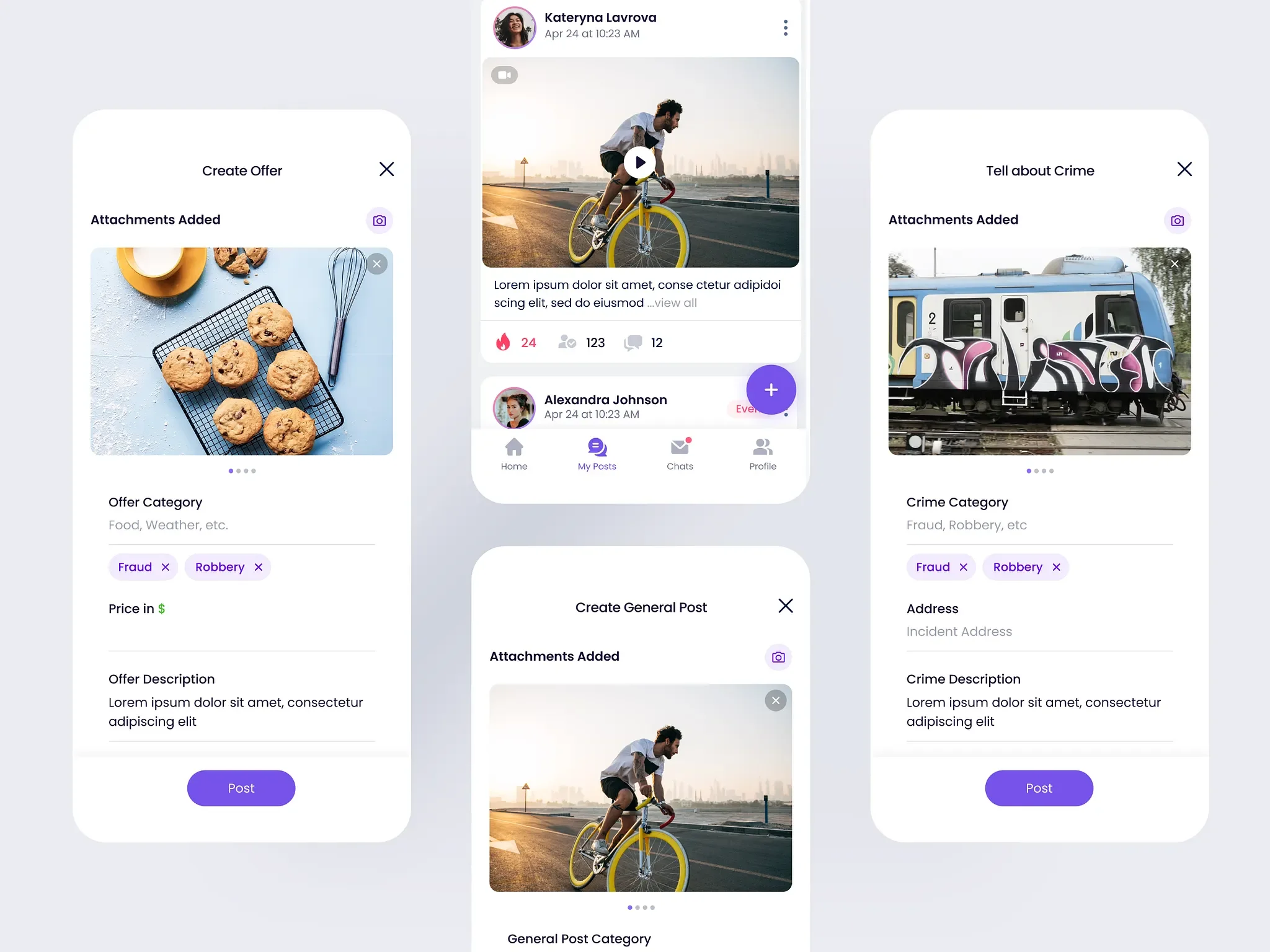
The experience needed to support community posts, interactive maps, messaging, business profiles, promotional content, stories, and local discovery inside one coherent product. At the same time, every new feature had to integrate into a scalable design system capable of supporting future product growth.
Discovery & Product Strategy
We started by analyzing how users interact with community platforms, local marketplaces, and modern social networks.
Instead of replicating existing products, we focused on identifying the moments that create long-term engagement: discovering nearby activities, receiving relevant recommendations, communicating instantly, and building trust through local communities.
This research helped define the product architecture, user flows, content hierarchy, and interaction principles before moving into interface design.
UX Challenges
-
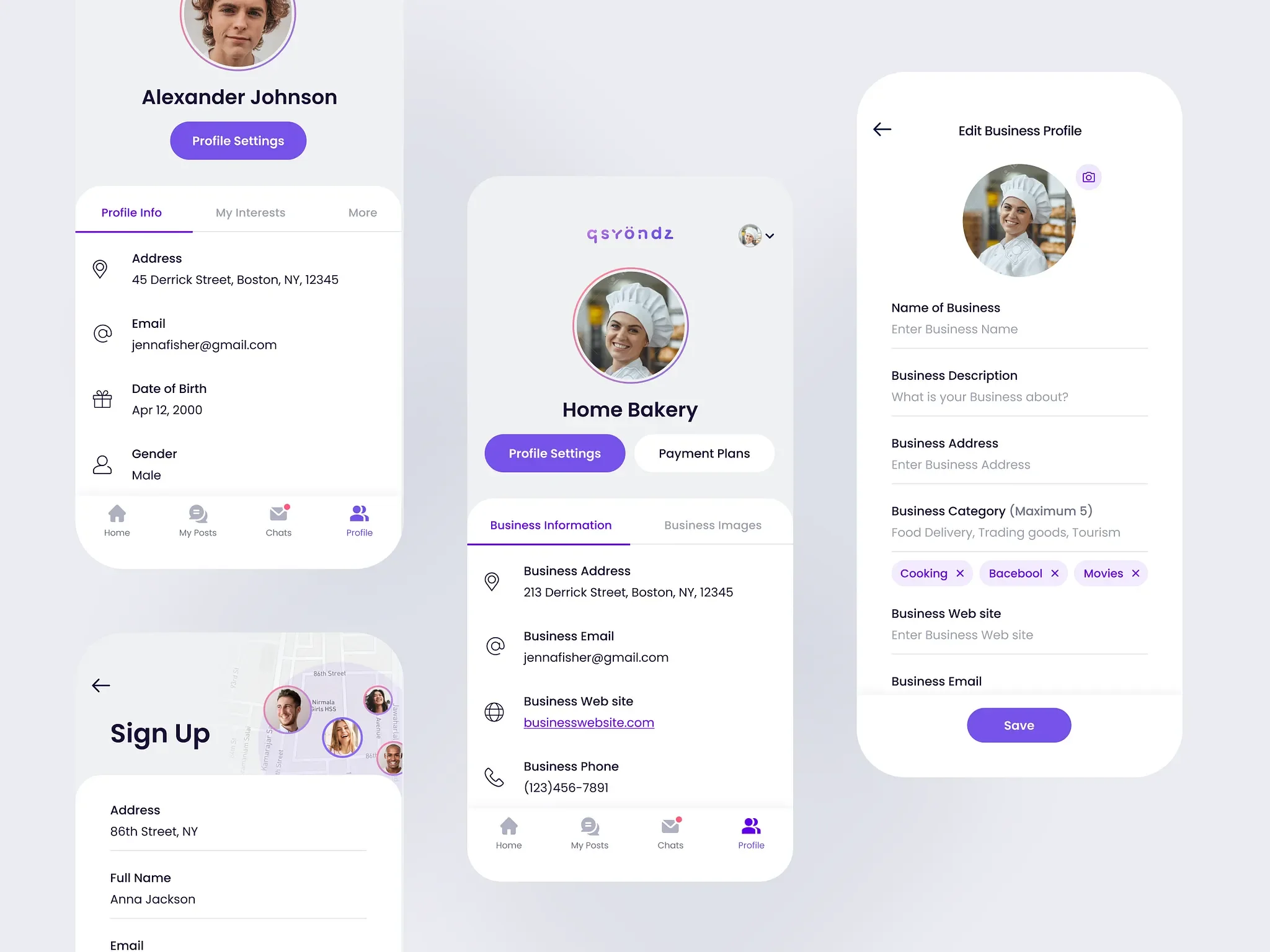
The application had to work equally well for residents and businesses. Rather than separating experiences into different apps, we designed adaptive user journeys that reveal relevant functionality depending on the user's goals.
-
Promotional content can quickly become overwhelming. Instead of pushing advertisements, business content was integrated directly into community feeds, recommendations, and local discovery, making commercial interactions feel native rather than intrusive.
-
Maps, feeds, stories, messaging, profiles, offers, and notifications all compete for attention.
The interface was carefully simplified using progressive disclosure, visual hierarchy, and contextual actions, allowing users to access advanced functionality without increasing cognitive load.
Design System
Because the platform was expected to evolve continuously, we created reusable UI foundations instead of isolated screens.
The design system included scalable components, adaptive layouts, spacing rules, typography hierarchy, interaction patterns, iconography, and reusable content modules.
This allowed new features to be introduced significantly faster while maintaining visual consistency across the entire product.
Key Features
-
Users can instantly discover nearby businesses, services, events, and community activity using an interactive map combined with personalized recommendations.
-
A dynamic feed enables users to share updates, announcements, photos, videos, recommendations, and community news while businesses can publish promotions and offers within the same experience.
-
Businesses receive customizable profiles where they can present services, promotions, media, contact information, and ongoing activities, turning every profile into a lightweight digital storefront.
-
Short-form content gives businesses another communication channel for promotions while helping users quickly discover what's happening around them.
-
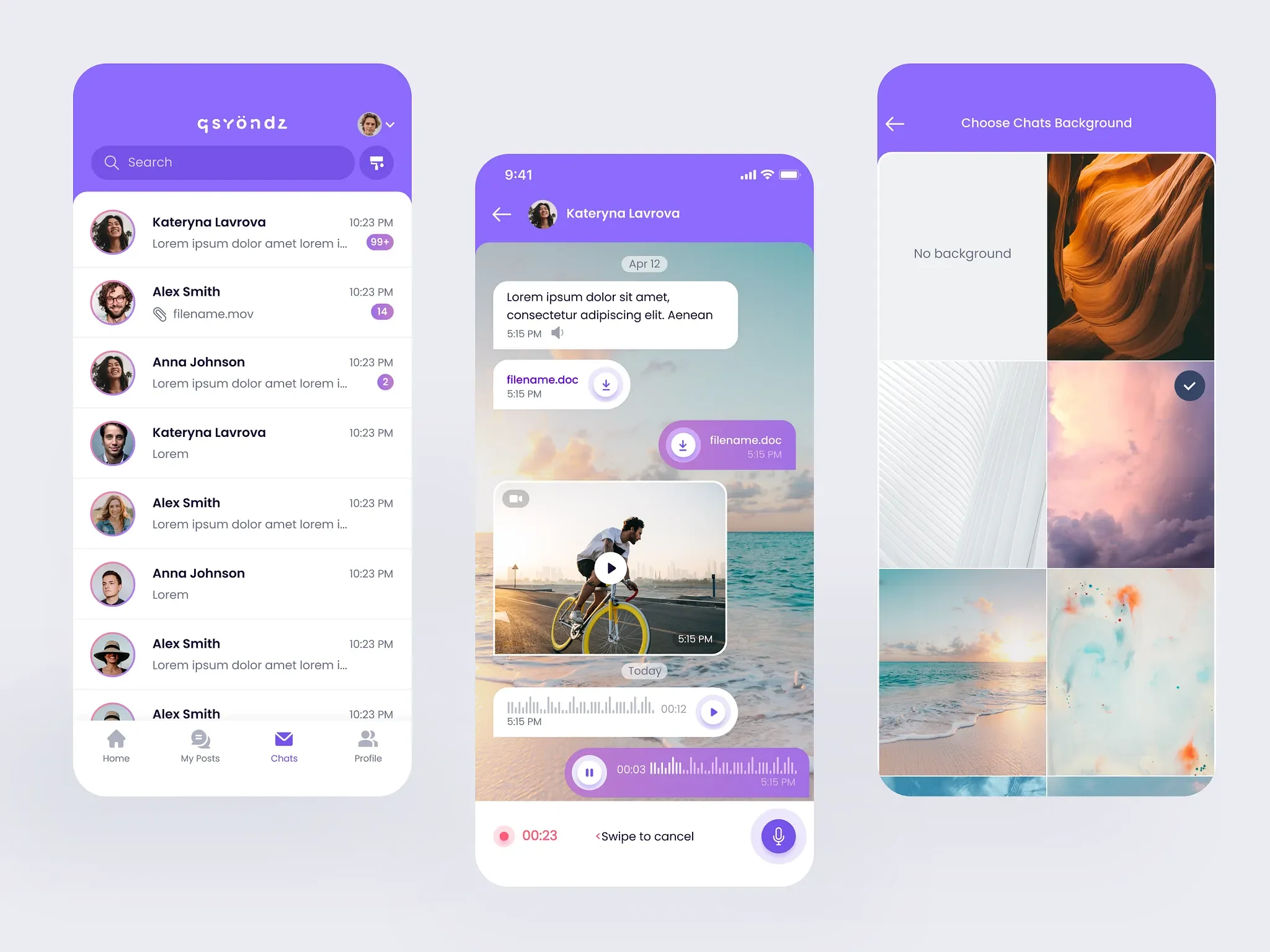
Built-in messaging removes friction between discovery and communication, allowing users to contact businesses or community members instantly without switching applications.
-
Personal profiles become the center of local identity, combining interests, activity history, connections, and personalized recommendations.
Visual Language
The interface follows a clean, modern visual language that prioritizes content over decoration.
Large imagery, generous spacing, soft gradients, and lightweight navigation create an experience that feels approachable despite the platform's complexity.
Every interaction was designed to reduce friction and encourage exploration without overwhelming first-time users.
Outcome
The final product successfully combines social networking, local discovery, and business promotion into one scalable ecosystem.
Rather than feeling like another marketplace, the platform encourages genuine community engagement while giving local businesses modern tools to increase visibility, communicate with customers, and grow organically.
The modular design system ensures that future functionality can be introduced without redesigning the product, making the platform ready for continuous expansion and long-term evolution.
