
Set the context
Show what information the system needs and which task it is helping the person complete.

AI product design
We design AI-enabled products and use AI to shorten the path from an early idea to something your team can see, test, and improve - without outsourcing product decisions to a model.

Designing AI experiences
We help teams create understandable, trustworthy interactions around generation, recommendations, automation, review, and human control.
Using AI in the design process
We use AI to explore directions, build early concepts, compare interface variations, and make uncertain ideas tangible faster.
AI products introduce questions that conventional interfaces often do not:
What is the system doing now?
What information influenced the result?
How certain is the output?
What can the user change, correct, or undo?
When should a person review or approve the result?
What happens when the system fails or produces something unexpected?
Rapid concepts
Turn a rough idea into something the team can review and challenge.
Interface variations
Compare different visual and structural directions before committing to detailed execution.
Product exploration
Explore flows, features, and edge cases early enough to change them cheaply.
Context-aware expansion
Generate new directions using the product's established design system, brand, business rules, and interaction patterns as constraints.
Human judgment remains accountable
AI can generate options. It cannot take responsibility for the product. Clearl remains accountable for user needs, information architecture, interaction design, accessibility, consistency, and the final design decision.
Context
AI exploration
Design decision
Prototype
Validation
Product-ready design
Useful AI interactions make the system understandable and leave room for human judgment.
Show what information the system needs and which task it is helping the person complete.
Present results in a format people can compare, edit, accept or reject.

Make review and approval steps explicit when an action needs human judgment.

Help users understand uncertainty, correct missing context and continue when a result is not useful.
Professionals demonstrate their skills; companies find people whose skills fit the role.
Benchler rethinks recruiting and talent discovery. IT professionals demonstrate their skills through an AI interview and remain on the bench, while recruiters define what a role requires and find people with verified skills.
See case studyFor IT professionals, the product centers on an AI interview, verified skills and continued discoverability. For companies, the journey begins with the role requirements and finding people whose skills fit them. The published product direction connects those paths through a shared matching model.
See case studyRecruitment connects two different decisions: professionals need a way to demonstrate what they can do, while recruiters need evidence that matches a role. Benchler brings those journeys into one product instead of treating candidate profiles and job requirements as unrelated information.
See case study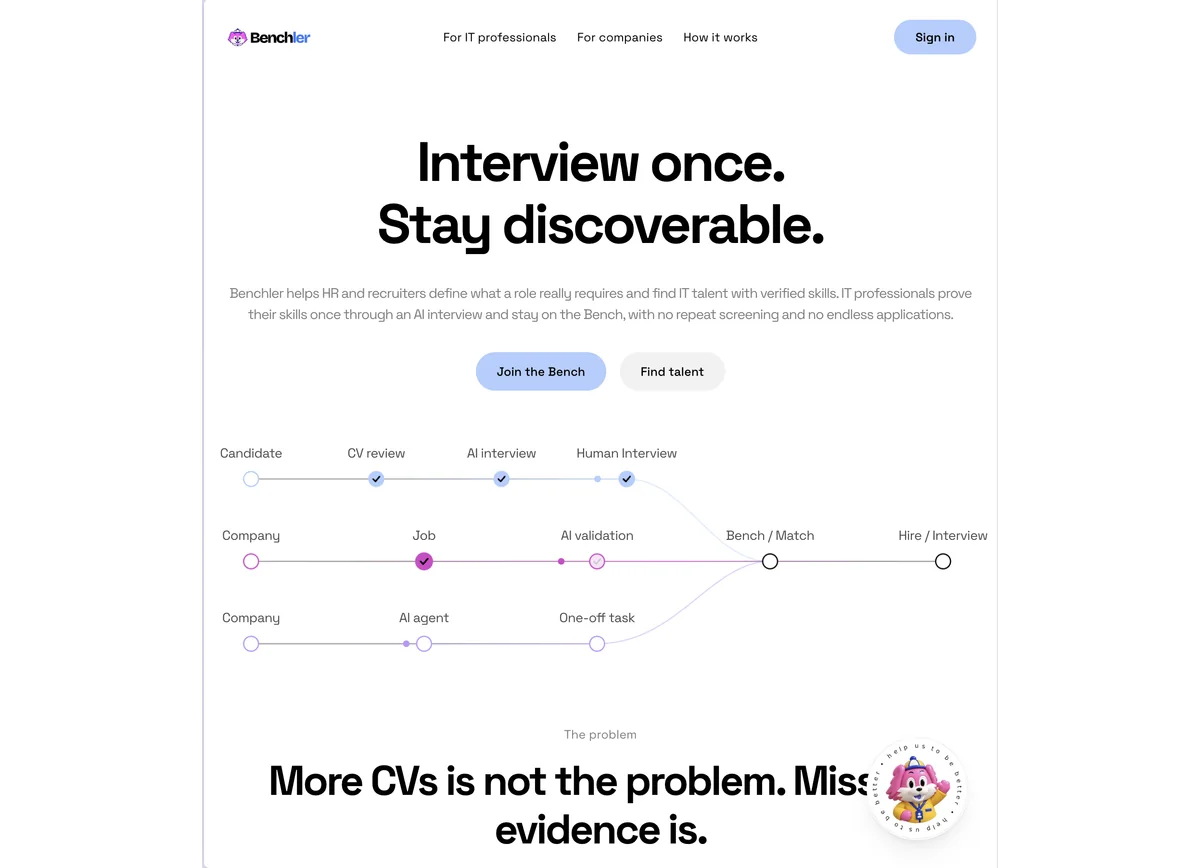
A recruitment platform where IT professionals prove their skills once and stay discoverable, while companies find talent through clearer role requirements.
Product discovery, UX audits, research and prioritization to clarify users, constraints and the next product direction.
HR tech and recruitment product design connecting candidates, verified skills and hiring requirements. Explore Benchler’s marketplace and brand identity.
Explore industryAI product design with clear inputs, understandable feedback and human review. Explore Benchler’s recruitment workflow and Clearl’s AI UX service.
Explore industry